
How to Market Your Small Business: A Realistic Playbook for Owners With No Time
Get specific about who you serve, claim your free profiles, pick one or two channels your customers actually use, and publish on a rhythm you can keep. A prioritized seven-step playbook for owners with no time or team.
Here is the short answer: define exactly who you serve, claim the free profiles that already exist for your business, pick one or two channels where those customers actually spend time, and publish on a schedule you can sustain for six months. That is the whole strategy. The rest of this article is the order to do it in, how much time each piece realistically takes, and what to skip.
The core principle: fewer channels, done consistently
Most small business marketing advice fails because it assumes you have a marketing team. You don't. You have maybe two to four hours a week, and every hour you spend on marketing is an hour you're not serving customers.
That constraint should shape everything. A business that posts on one channel every week for a year will beat a business that launches on six channels and abandons five of them by March. Consistency compounds; scattered effort doesn't.
Three rules follow from this:
- Depth beats breadth. One channel done well outperforms four done badly.
- Sustainable beats impressive. A rhythm you can keep while exhausted is worth more than an ambitious plan you'll drop.
- Own your story. Before you touch any channel, you need a clear answer to "who is this for and why should they pick you?" Every post, ad, and listing borrows from that answer.
With that frame, here are the steps in priority order. Do them in sequence — each one makes the next more effective.
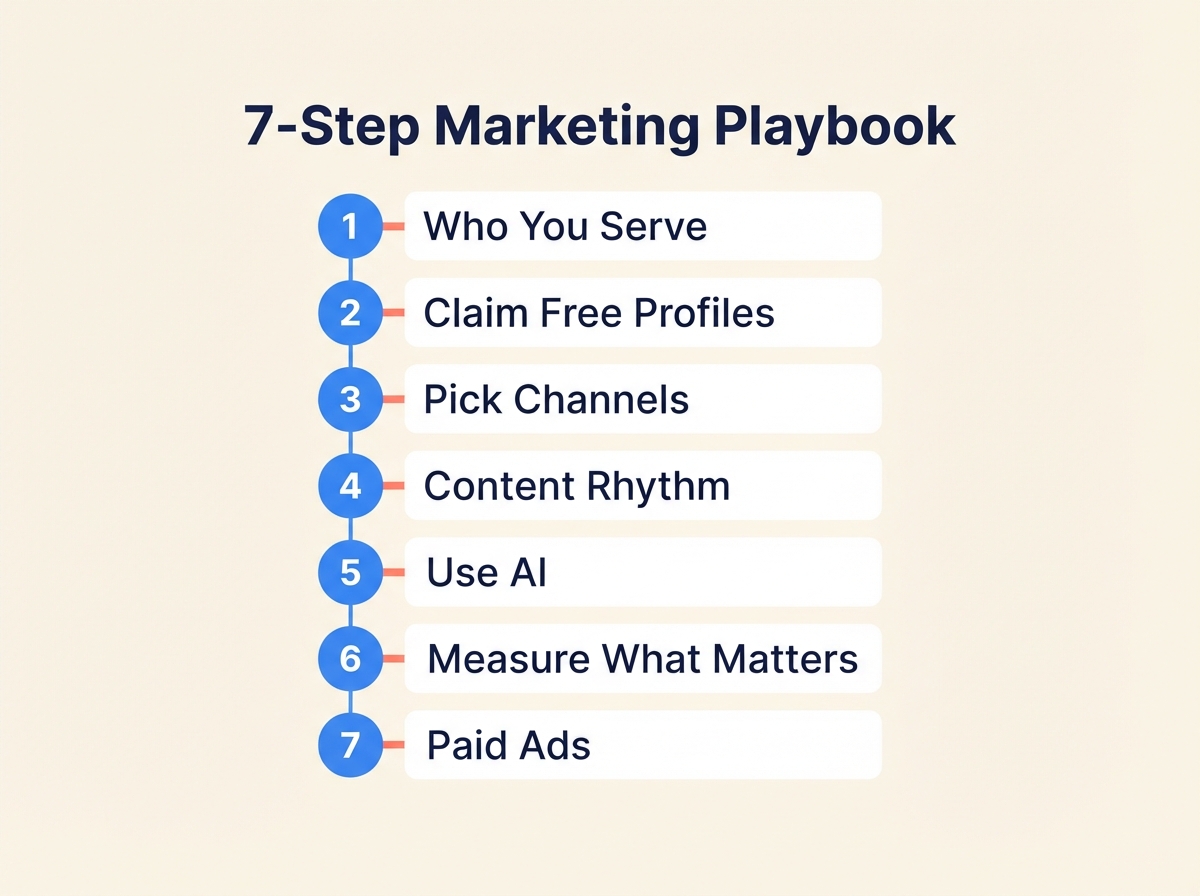
Step 1: Get specific about who you serve and why they choose you
Skip the formal buyer-persona exercise. Instead, answer three questions in plain language:
- Who is my best customer? Not "everyone who needs a plumber" — the specific person: "homeowners in this county with houses older than 20 years who want problems fixed the same week."
- What problem do they actually hire me for? Customers rarely buy the thing you sell; they buy the outcome. A bookkeeper isn't selling ledgers, she's selling "you'll never be surprised at tax time."
- Why me and not the alternative? Faster, closer, more specialized, friendlier, better guaranteed — pick the one that's true and provable.
Write the three answers down in a paragraph. This becomes your filter for everything else: which channel to pick, what to post, what your ads say. When you're tired at 9 p.m. deciding what to publish, this paragraph decides for you.
If you genuinely don't know why customers choose you, ask five of them. "What made you pick us?" is a five-minute phone call and worth more than any keyword tool.
Step 2: Claim your free profiles before spending a single dollar
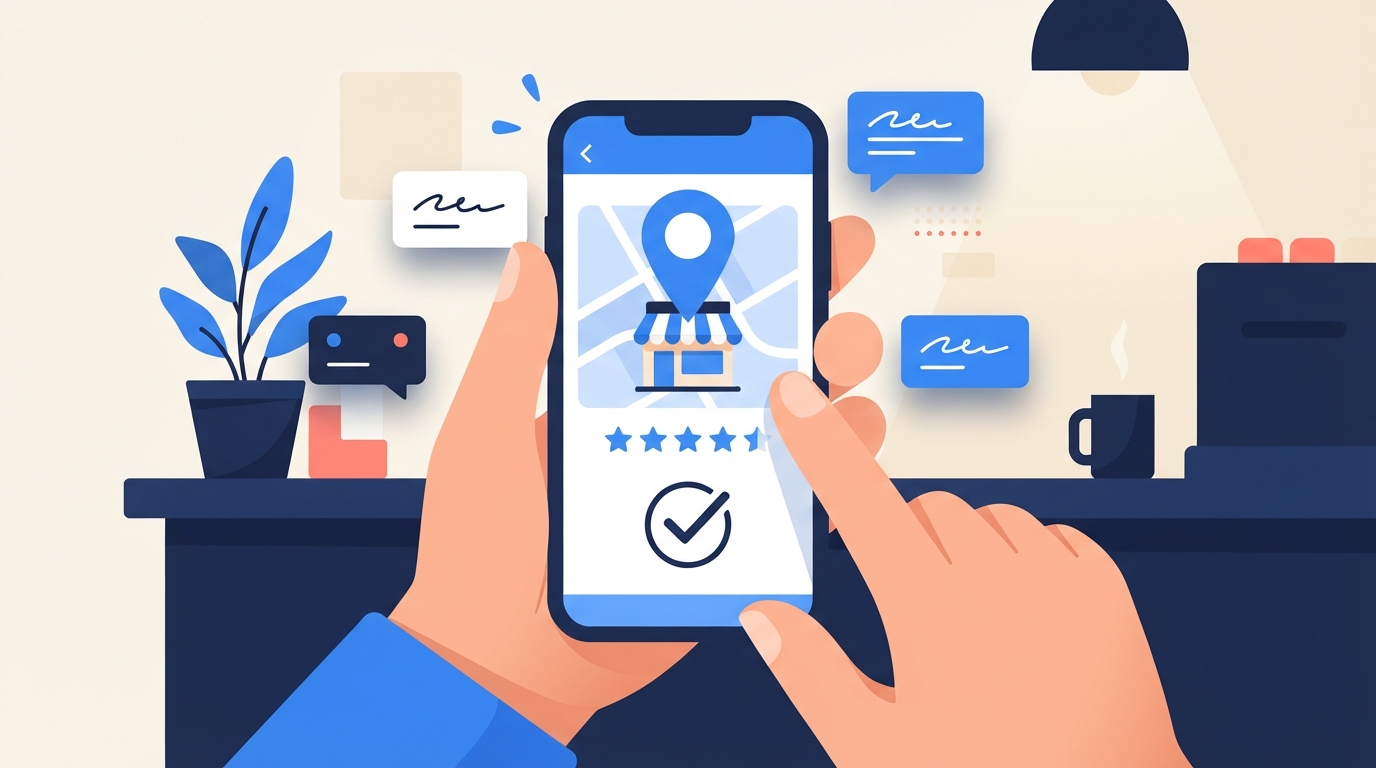
Before building anything new, claim what already exists. These listings are free, they show up when people search your business name or category, and an unclaimed or half-empty profile actively costs you customers.
- Google Business Profile is the highest-priority item on this entire list for any business serving local customers. It's what appears in Google Search and Google Maps when someone nearby searches for what you do. Claim it, verify it, and fill in every field: hours, photos, services, description, booking link. Then keep it alive — answer questions, post occasional updates, and reply to every review, good or bad. Reviews are the closest thing local businesses have to a rankings lever, and asking happy customers to leave one is the single best marketing habit you can build.
- Bing Places, Apple Maps, and Yelp take an hour combined to claim. Do it once, keep the hours accurate, and move on.
- Your website doesn't need to be fancy. One clear page that says what you do, who it's for, where you are, and how to contact you beats a beautiful ten-page site that never gets finished. Make sure your phone number is clickable on mobile.
Total setup cost: roughly one focused afternoon. Ongoing cost: about 15 minutes a week for review replies and updates. Nothing else in marketing has this ratio of effort to payoff.
Step 3: Pick one or two channels where your customers actually are

Now — and only now — choose your active channels. Not the channels you enjoy, not the ones marketing blogs hype: the ones where your specific customers (from Step 1) already spend attention.
A rough map:
| Channel | Best for | Realistic time per week | |---|---|---| | Google Business Profile | Any local business (restaurants, trades, clinics, salons) | 15 min | | Instagram | Visual products and services: food, retail, beauty, fitness, interiors | 1–2 hrs | | Facebook | Local community businesses, 35+ audiences, groups and events | 1 hr | | Short video (Reels/Shorts) | Personality-driven businesses that can show process or before/after | 2–3 hrs | | Email newsletter | Repeat-purchase businesses: cafés, salons, coaches, e-commerce | 1 hr | | Blog / SEO | Considered purchases people research: B2B, legal, financial, medical, home services | 2–3 hrs | | LinkedIn | B2B services selling to other businesses | 1 hr |
Pick one primary channel and, at most, one secondary. If you're unsure, default to Google Business Profile plus whichever social platform your last ten customers mentioned or where your competitors get real engagement (comments from actual locals, not bot likes).
One more channel that doesn't fit the table: word of mouth. It's most small businesses' biggest source of new customers, and you can influence it. Ask for referrals directly, make it easy ("forward this to a friend and you both get 10% off"), and treat every review request as word-of-mouth infrastructure. It costs nothing but the asking.
Step 4: Set a content rhythm you can keep for six months
Decide your publishing cadence based on your worst week, not your best one. If you can realistically produce two posts a week during your busiest season, commit to two — not five.
A sustainable baseline for a solo owner:
- 2–3 social posts per week on your primary channel
- 1 email per month if you have a list (start collecting addresses now even if you don't send yet)
- 1 blog post per month only if SEO is your chosen channel
Batch the work. One hour on a quiet Monday planning and drafting the week's posts beats trying to invent something daily. Keep a running note on your phone of post ideas — customer questions, before/afters, behind-the-scenes moments, mistakes you see people make. Customer questions alone can feed a content calendar for a year: every question you've answered twice in person is a post.
And lower the quality bar deliberately. A useful, slightly imperfect post that ships beats a polished one that doesn't. Your customers are not grading your graphic design; they're deciding whether you seem competent and trustworthy.
Step 5: Use AI to remove the production bottleneck
For most owners, the hard part isn't strategy — it's production. Knowing you should post is easy; producing a decent graphic, caption, and hashtags at 9 p.m. after a full workday is what actually breaks the rhythm.
This is the one place where AI tools genuinely change the math for a one-person operation. General-purpose chatbots can draft captions, but you still end up assembling visuals, resizing for each platform, and copy-pasting into each app — which is where most people quit.
Purpose-built tools close that gap. MarketingStudios.AI, for example, is an AI content studio built for small businesses: you enter your brand information once (it can auto-extract your brand colors and tone from your website), and it generates finished marketing content — multi-slide card-news graphics, SNS posts with image, caption, and hashtags, blog drafts, ad banners, product detail pages, and short AI videos — then publishes directly to Instagram, Facebook, Threads, YouTube, and WordPress. The free plan includes 10 AI images and 2 blog drafts with no credit card, which is enough to test whether it fits your workflow.
Whatever tool you use, the goal is the same: cut content production from hours to minutes so the rhythm from Step 4 survives contact with a busy week. Just keep one rule — always read and adjust AI output before publishing. You're using AI for production speed; the judgment about what sounds like your business stays yours.
Step 6: Measure only what matters

You don't need a dashboard. You need to know two things: where customers come from, and whether that's changing.
- Ask every new customer how they found you, and tally it in a note or spreadsheet. This one habit outperforms most analytics setups for a small operation.
- Watch actions, not applause. Calls, direction requests, website clicks from your Google Business Profile, messages, bookings, and sales are signals. Likes and follower counts mostly aren't — they feel like progress while proving nothing.
- Review monthly, not daily. Once a month, spend 20 minutes: what did I publish, what happened, what's the source tally say? Then adjust one thing. Daily checking just makes you anxious and reactive.
If after three months a channel shows zero movement in real actions, you're allowed to quit it and try another. That's not failure; that's the system working.
Step 7: Add simple paid ads only after the organic basics work
Paid ads amplify what already works — they can't fix an unclear offer or an empty profile. Run them only after Steps 1–6 are in place, because ad clicks land on your profile and website, and if those are weak you're paying to make a bad first impression.
When you're ready, start narrow:
- One campaign, one goal. For local businesses, a simple Google Search campaign on the exact terms customers use ("emergency plumber [your town]") is usually the highest-intent starting point. For visual products, a boosted post of your single best-performing organic content is a reasonable first test on Meta.
- Set a budget you can lose without pain, and treat the first month as tuition, not revenue. You're learning which messages and audiences respond.
- Judge by cost per real action — a call, a booking, a sale — not by impressions or clicks. An ad that's seen less but converts is the winner.
If ads don't pay for themselves after a fair test, pause them and go deeper on organic. Plenty of healthy small businesses grow on Google Business Profile, referrals, and one social channel alone.
What this looks like in practice
A realistic weekly footprint once you're set up: 15 minutes on your Google profile and reviews, one batching session for the week's posts (under an hour if you're using an AI studio like MarketingStudios.AI to produce the visuals and captions), and a monthly 20-minute review. Call it two to three hours a week — sustainable for one person, and enough to compound meaningfully over a year.
Start with Step 1 this week. Write the who/what/why paragraph, claim your Google Business Profile, and pick one channel. Everything else builds from there.
Frequently asked questions
How much should a small business spend on marketing?
Start with time, not money. Steps 1–6 above cost nearly nothing but a few hours a week, and they're the highest-return work available to you. Add paid spend only once your profiles and content are solid, starting with a small monthly test budget you could lose entirely without stress — then scale only what demonstrably brings in customers at a cost lower than what those customers are worth.
How long until marketing shows results?
It depends on the channel. A completed Google Business Profile and a few new reviews can move local visibility within weeks. Social channels typically need two to three months of consistent posting before engagement becomes customers. SEO and blogging are the slowest, often six months or more — which is exactly why consistency matters more than intensity. Judge any channel after three months of honest effort, not three weeks.
Do I really need social media?
Not necessarily every platform, and possibly none. If your customers find businesses like yours through search and referrals — many trades, professional services, and medical practices — a strong Google Business Profile, steady reviews, and a clear website can carry you. Social media earns its time cost when your customers genuinely discover or evaluate businesses there. Choose based on where your customers are, not on a feeling that you're "supposed to" be everywhere.
Should I hire a marketing agency?
Usually not at first. Agencies work best when you already know your customer, your message, and which channel converts — otherwise you're paying someone to guess on your behalf, and you can't evaluate their work. Run the playbook above for a few months first; if a channel clearly works and your own time becomes the bottleneck, that's the right moment to bring in outside help — with the data to direct them.