
35 Social Media Post Ideas for Small Businesses (You Can Post Today)
Rotate six proven post types — behind-the-scenes, social proof, educational, promotional, engagement, and seasonal — and you'll never stare at a blank feed. Here are 35 concrete ideas a small business can post today.

The fix for a blank feed isn't more creativity — it's a rotation. Cycle through six post types (behind-the-scenes, social proof, educational, promotional, engagement, seasonal) and you always know what's next. Below are 35 specific ideas, each with enough execution detail to post one within the hour.
Which Post Types Fit Which Platform
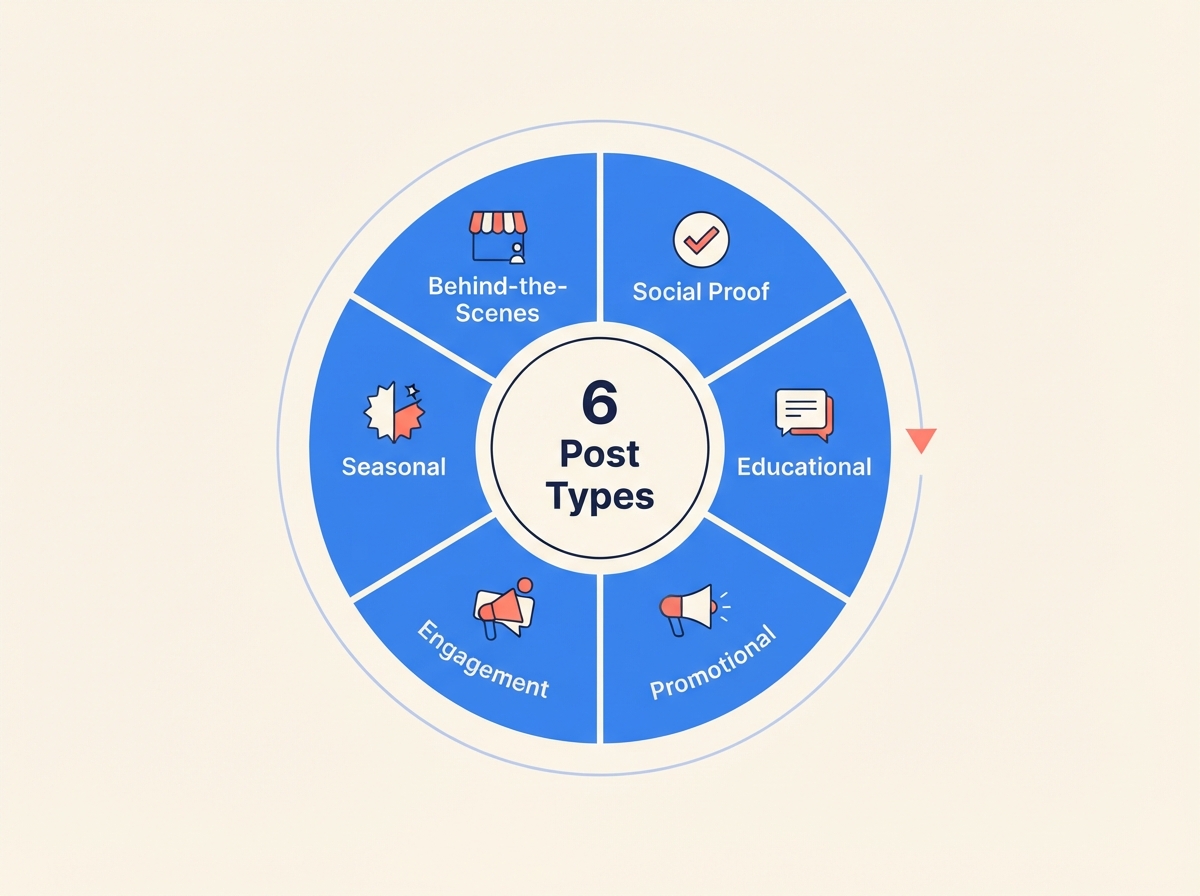
Before the list, a quick map. Not every idea belongs everywhere, and effort varies a lot. Use this to match ideas to the time you actually have this week.
| Post theme | Best platforms | Effort | How often | |---|---|---|---| | Behind-the-scenes | Instagram Stories, TikTok, Threads | Low | 1–2× per week | | Social proof | Instagram feed, Facebook, Google profile | Low | 1× per week | | Educational | Instagram carousels, LinkedIn, blog | Medium | 1–2× per week | | Promotional | Instagram feed, Facebook | Medium | ~20% of all posts | | Engagement | Stories, Threads, Facebook Groups | Low | 1× per week | | Seasonal / timely | All of the above | Low–Medium | When relevant |
The ratio matters more than the schedule: keep promotion to roughly one post in five. The other four earn the attention that makes the fifth one work.
Behind-the-Scenes Ideas (1–6)

People buy from small businesses because there's a person behind them. Show that person.
1. Your workspace, right now. Take one photo of your desk, kitchen, shop floor, or van exactly as it looks today and caption it with what you're working on. Slightly messy beats staged — it reads as real.
2. How it's made. Film 15–30 seconds of your process: packing an order, prepping ingredients, setting up on a job site. No talking required; text overlay and trending audio are enough.
3. Meet the owner. Introduce yourself, say why you started the business, and share one thing customers would never guess. Re-run a version of this every few months — new followers never saw the first one.
4. A mistake and what you changed. A batch that failed, a job that ran late, a supplier that fell through — and the fix you put in place. Owning a small failure builds trust faster than another success story.
5. Tools of the trade. Show the one piece of equipment or software you'd replace within a day if it broke, and explain why. Niche audiences love gear talk.
6. Before open, after close. The quiet moments: flipping the sign, stacking chairs, loading the van at 6 a.m. These low-effort shots consistently outperform polished promos on Stories.
Social Proof Ideas (7–12)
Nothing you say about your business is as convincing as what a customer says. Your job is just to package it.
7. Screenshot a review. Drop a Google or Yelp review onto a simple branded background, add one line of thanks, post it. One good review can become three posts if you pull different quotes.
8. Repost a customer's photo. When someone tags you, ask permission, reshare, and credit them. It costs you nothing and tells every follower that customers post about you unprompted.
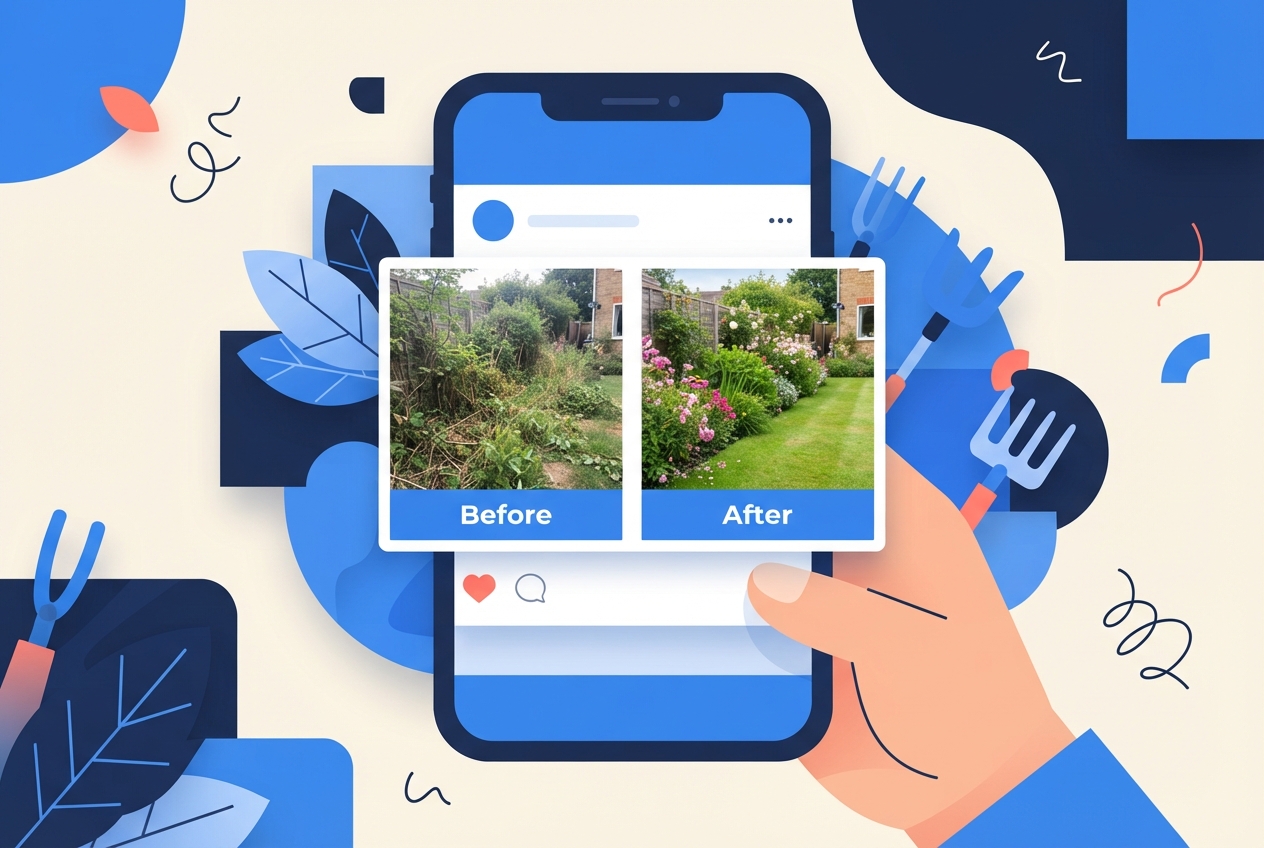
9. Before-and-after. The single most persuasive format for service businesses — cleaning, landscaping, repair, design, fitness. Same angle, same lighting, two images side by side.
10. A number that proves the work. "142 orders shipped this month." "37 gardens winterized." Small numbers are fine; specificity is what makes it credible.
11. A three-slide case study. Slide one: the customer's problem. Slide two: what you did. Slide three: the result, ideally in the customer's own words.
12. Reply to a testimonial publicly. Instead of just posting a kind review, respond to it in the caption — what the job involved, what made it tricky. It turns praise into a story.
Educational Ideas (13–18)
Teach what you know and you become the obvious choice when the buyer is ready. These take more effort but keep working for months.
13. Answer your most-asked question. Whatever you answer in DMs every week — post it once, properly, and link back to it forever.
14. A "stop doing this" tip. Name the most common mistake customers make before they come to you, and what to do instead. Mild contrarian framing earns saves and shares.
15. A five-slide mini how-to. Pick one narrow task your audience struggles with and walk through it in a carousel: one step per slide, big text, no clutter. Carousels are the highest-effort format on this list — if design is the bottleneck, a tool like MarketingStudios.AI generates finished multi-slide card news graphics and SNS posts (image, caption, and hashtags) from your brand info, pulling your colors and tone from your website so everything stays on-brand.
16. Explain your pricing. Break down why your product or service costs what it does — materials, hours, expertise. It filters out bargain hunters and disarms the objection before the sales conversation.
17. Bust a myth in your industry. Pick one belief customers hold that costs them money or results, and correct it with a concrete example.
18. A plain-English comparison. "X vs. Y: which one do you actually need?" Comparing two options you sell — or one you sell against one you don't — positions you as an honest advisor.
Promotional Ideas (19–24)
Promotion works when it's specific and occasional. These formats sell without sounding like a billboard.
19. Single product spotlight. One product, one strong photo, three reasons it earns its place. Resist the urge to cram your whole catalog into one post.
20. Honest availability. "Two installation slots left this month" or "Last restock before the holidays." Real scarcity, stated plainly, converts; fake countdowns erode trust.
21. A seasonal bundle. Pair two or three items or services that make sense together and price the bundle slightly under the sum. The post writes itself: what's in it, who it's for, when it ends.
22. The product in the wild. Show your product being used in a real customer context instead of on a white background. Context sells the outcome, not the object.
23. A follower-only perk. Early access to a drop, or a small code shared only on social. It gives people a concrete reason to follow, not just to like.
24. The "who this is for" post. Describe your ideal customer's situation precisely — the problem, the frustration, the moment they realize they need help. People tag themselves in the comments. This qualifies buyers better than any discount.
Engagement Ideas (25–30)
Comments and shares teach the algorithm to show your other posts. Once a week, post something that exists purely to start a conversation.
25. This-or-that poll. Two options relevant to your niche — morning appointments or evening, classic flavor or the new one. Stories polls take 60 seconds to make.
26. Ask for a recommendation. "Best local coffee near [your area] — go." People love giving advice, and reply threads are algorithm fuel. Bonus: you learn where your customers actually go.
27. Fill in the blank. "The one thing I always forget when ___ is ___." Keep it inside your niche so replies double as audience research.
28. Caption this. Post an odd or funny photo from your workday and ask for captions. Low effort, high reply count.
29. A mild unpopular opinion. Take an actual stance on a debate in your field — the tool everyone overrates, the trend that's a waste of money. Defensible and specific, not edgy for its own sake.
30. Let followers vote on what's next. Next flavor, next colorway, next service to add. People who voted come back to see if they won — and they feel invested in the result.
Seasonal and Timely Ideas (31–35)
Timely posts feel current with almost no extra creative work, because the calendar does the ideation for you.
31. Local event tie-in. A festival, market, game day, or school calendar moment near you — how your business fits in, or just that you'll be there.
32. A holiday deadline post. "Order by December 12 for Christmas delivery." "Book fall maintenance before the first frost." Deadlines are the most useful thing you can post in a busy season.
33. A niche holiday — if it's genuinely yours. National Coffee Day for a café, yes. For an accounting firm, skip it. One relevant niche holiday beats ten forced ones.
34. A quarter or year recap. Orders shipped, projects finished, one lesson learned, one thing changing next quarter. Recaps are easy to write because the material already exists.
35. Weather-triggered posts. First snow, heatwave, rainy week — pre-write two or three of these and post them when the trigger hits. They feel spontaneous; you made them in advance.
Turning 35 Ideas Into a Posting Rhythm You Can Keep

A list of ideas fails without a system, so build the smallest one that works. Pick three or four themes from above as your content pillars — for most small businesses, behind-the-scenes, social proof, and educational, plus promotional in that one-in-five ratio. Assign each pillar a loose slot ("Monday: tip, Wednesday: behind-the-scenes, Friday: review") so you're never deciding what to post and what to say at the same time.
Then batch. Block ninety minutes once or twice a month, produce six to eight posts in one sitting, and schedule them. Batching beats daily improvisation because you make creative decisions once instead of thirty times. Squeeze each piece of effort twice: a five-slide carousel becomes five single Story frames, a good review becomes a graphic and a caption anecdote, a blog post becomes three tip posts.
If production time is the real constraint, this is where AI tooling earns its keep. MarketingStudios.AI takes your brand info once and generates finished content — SNS posts, multi-slide graphics, ad banners, blog drafts, and short AI videos — and can publish directly to Instagram, Facebook, Threads, YouTube, and WordPress. The free plan (10 AI images, 2 blog drafts, 1 deep research) needs no credit card, which is enough to batch your first week or two and see whether the rhythm holds.
Finally, check your numbers monthly, not daily. Look at which pillar earned the most saves, shares, and comments — then shift your ratio toward it. The rotation gets you posting; the monthly review makes the posting compound.
FAQ
How often should a small business post on social media?
Three to five posts a week is plenty, and consistency beats volume. A business that posts three times a week for six months will outperform one that posts daily for three weeks and disappears. Pick a frequency you can sustain on your worst week, not your best.
What should I post when I have no ideas?
Fall back on the two formats that never run dry: answer a question a customer asked you this week, or share something from today's work — a photo of the job, the order, the prep. If you keep a running note on your phone of customer questions and workday moments, you'll always have a backlog.
Do I need a graphic designer to make good social media posts?
No. A clear phone photo with good lighting outperforms a generic stock graphic, and behind-the-scenes content is expected to look unpolished. For the formats that do need design — carousels, promos, banners — templates or AI generation tools cover what a solo operator needs.
Should I post the same content on every platform?
Reuse the idea, adjust the format. A before-and-after works everywhere, but on Instagram it's a two-image post, on TikTok it's a transition video, and on Facebook it's a photo with a longer story in the caption. Start with the one or two platforms where your customers actually are, and expand only when those are consistent.